
August 2026 Release – Meet Your New Agentic Pentest Team!
AttackForge Product Update · August 2026
While the competition was … busy … being merged with another company – AttackForge has shipped another exciting release!
😃 Our engineering team has spent the last two months heads-down, and this time the big story is 🥁🥁🥁agents - real, working, wired-into-your-lifecycle agents, not another chatbot bolted to the side of the platform.
We've rounded up everything below. Full detail, as always, lives on our Support Centre - this post is the highlight reel.
🤖 AI Agentic Workflows Have Landed
This is the headline, so let's not bury it: AttackForge now ships with over 60 new MCP tools, and your AI agents - whatever you're running, wherever they live - plug straight in. Bring Copilot Studio, bring OpenClaw, bring Microsoft Foundry, bring the stack your team hacked together at 2am last quarter. If it speaks HTTP and MCP, it works inside AttackForge. No lock-in, no "our AI only." Watch the walkthrough on YouTube.
Here's what actually shipped:
Launch the Hackbots - Trigger a swarm of pentesting agents straight from a project Action and watch findings stream in live. Agents enumerate, notice the weak permission, pivot to the adjacent host, and chain low-severity issues into real impact - the way an attacker actually works, not the way a scanner does.
Agents that document their own test cases - Your agents now register their procedures as real Test Cases, complete with execution flows, notes, outcomes and linked vulnerabilities. That turns "found 12 issues" into "executed 340 of 400 checks" - the difference between an assertion and an assessment, and the artefact your auditors actually want.
Drive agents using your own project test cases - point the agent at the test cases already allocated to the project and let it work the methodology you sold, not the one it improvised. Scope containment, a measurable finish line, and a hostile target can't talk your agent into wandering off-script.
Agentic vulnerability enrichment - Point an agent at a project, a vulnerability, or a writeup - one or a hundred at a time. CVE, NVD, EPSS, KEV, Exploit-DB, vendor advisories and GitHub PoCs get synthesised straight into the finding. Then findings get deduped and clustered, and writeups get auto-drafted in the client's language. Before-and-after on a vulnerability writeup? Like night and day. 🌗
Agentic retesting - Arguably the highest-value automation target in the whole lifecycle, because the hard thinking is already done. Retests fire the moment a fix is marked ready, run in parallel at scale, and log bulletproof, repeatable evidence. ⚠️ If you want a human to make a call – not a problem. Agents do the job on attempting to reproduce a known exploit – while you make a call to close vulnerability (or not).
Agentic executive summary - Two to four hours of senior consultant time - saved. One voice across the whole report, audience-tailored, with the cross-finding narrative that actually gets acted on ("three of your five criticals share a root cause"). Writes straight into the project's Reporting section - AI drafts, your tester signs off.
Agentic attack chain analysis – Attack Chains are one of the signature features of AttackForge. Customers have been asking to make it easier to identify and build them. Here we give it to you - turning a list of mediums into a proper story with impact, finding the non-so-obvious chains that human might miss, and maps everything to ATT&CK and Kill Chain automatically. ⚠️ Human validation still required - someone needs to confirm the pivot actually works in the target environment.
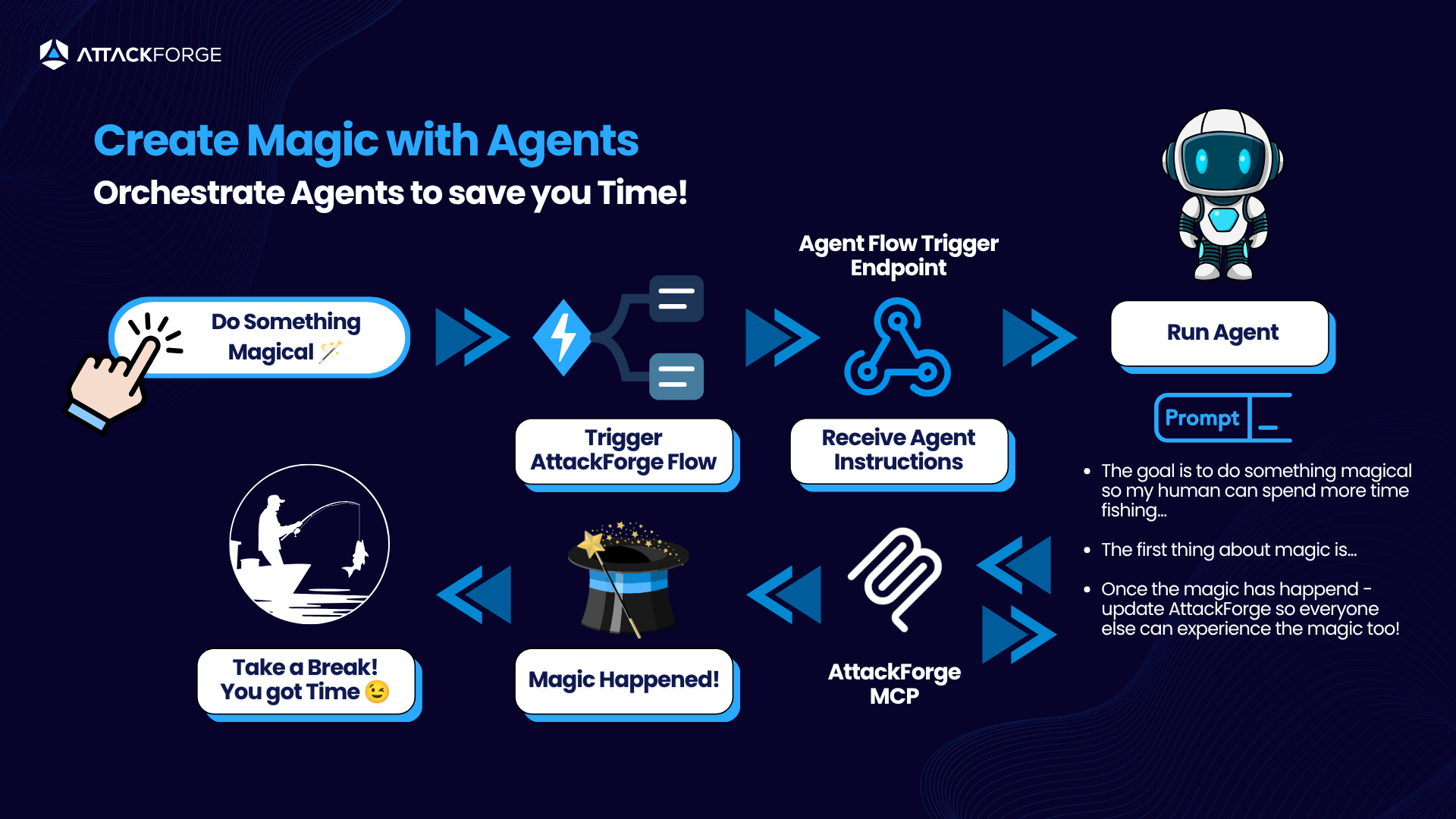
It all hangs together on the features you already know: an AttackForge Action (the button your team clicks) fires an AttackForge Flow (validate, enrich, route, secure), which triggers your agent over HTTP, which writes results straight back through the AttackForge MCP. Secrets, IP whitelisting and Authorization Keys are supported on every trigger, and MCP tool scoping means you grant each workflow exactly the access rights it needs - nothing more.
Full guides, prompts and tool lists are in the docs: AI Agentic Workflows. 🔒 One security note if you're standing up OpenClaw: harden it first, the default configuration is not secure out of the box - a reverse proxy, IP whitelisting and authorization keys are your friends.
Now go launch some hackbots. 👾
🙋 Create Forms on Actions
Actions have always been the "one button, infinite workflows" feature - click it, an AttackForge Flow fires. Powerful, but not yet interactive… Not Anymore!
Custom Forms on Actions let you attach a fully configurable form to any Action, so whoever's clicking it supplies exactly the context the workflow needs, right at the moment they click. Build the sections and fields into the Action, the form shows the instant someone runs it, and the answers land in data.form inside your Flow - ready to validate, transform, branch on, or forward on. Setup is in three steps: edit the Action, add your fields, save.
Why it matters:
Context capture at the point of intent - the scope caveat, the ticket reference, the "don't touch prod" instruction gets captured while it's fresh, instead of lost in a Slack message nobody can find later.
Safer automation - ask the confirming question before the workflow runs, and let your Flow validate and abort if the answers don't check out.
Self-documenting workflows - every Action Run now carries the inputs that shaped it, so "why did this fire, and with what parameters?" has an answer in the run, not in someone's memory.
One workflow, whole team - share it with AttackForge Roles, Groups or Users and everyone gets the same guardrails, junior tester or principal consultant alike.
And here's the killer use case: dynamic agent prompts. An AI agent is only as good as the context it's given, and without a form, an agentic Action fires the exact same directive every time regardless of client, scope or environment. Click Launch AI Hackbots now and a form appears first, gathering the specifics for this assessment - which flow into your Flow for validation and enrichment before hitting the agent's directive. Safer, more flexible, better documented, and reusable by the whole team.
A few ideas for your future Custom Form Action: agent scoping and testing windows, QA review requests, risk-acceptance justifications, on-demand scan profiles, custom export filters, ticket creation fields, retest triggers, and capturing the reason behind a delegated privileged task. And of course - AttackForge Action Forms support field-level access control, so only the authorized people fill in the details and everything else stays out of reach.
Go make your buttons smarter. 🧾✨
✨ Reimagined, Twice Over
Two long-standing corners of AttackForge got a ground-up rebuild this release - enough of one that "Reimagined" is right there in the feature name.
Retesting Rounds, Reimagined. Five new capabilities give your security team full control over the retest lifecycle end to end: click a round's name and the whole thing opens up; a new Approved status lets you review and accept a request before work begins (with an automatic email back to the requestor - no chasing); rounds stay editable at any point before completion, with editing rights following status (Requested → the requestor, Approved → your team, Completed/Cancelled → locked); Custom Fields capture whatever your process needs, right down to a ticket reference or an approver; and every projects table - Dashboard, Analytics, Groups, Portfolios, Streams, all of it - now has an expand arrow that unfolds a project's retest rounds right underneath, no navigating away required. The requestor supplies the essentials, your team layers on the rest, and nobody's chasing a spreadsheet to find out what's still outstanding. 🎯
Review Notes, Reimagined. We rebuilt the review experience from the ground up so it lives right next to the fields being reviewed, instead of off in a separate panel. Unresolved note counts now sit beside the field they're about; replies live in proper threads; composing happens in a spacious rich-text editor that slides up in a resizable sheet; notes can be marked resolved and filtered by Open, Resolved or All; and email notifications now deep-link straight to the exact note - even deep inside a thread - highlighted and ready to action. Happy reviewing! 🎉
🗓️ Updated Knowledge Base: Test Suites and Writeups Libraries
Twelve frameworks. All current. All ready to import, as AttackForge-formatted JSON - no conversion, no cleanup, no "I'll do it next quarter."
On the Test Suites side:
the full MITRE ATT&CK v19.1 matrix trio - Enterprise, Mobile and ICS, all on current technique IDs and sub-techniques;
a freshly updated MITRE ATLAS v2026.06 for prompt injection, model evasion, data poisoning and supply-chain attacks on the AI systems everyone's suddenly shipping to production;
the OWASP web app testing workhorse, WSTG 4.2;
the full OWASP ASVS 5.0.0 verification suite packaged by level - Level 1, Level 2, Level 3 - so you can scope an engagement to exactly the assurance level the client is paying for; and
OWASP MASTG v2 (2026.01), platform-split for iOS and Android, so mobile testers aren't wading through the other platform's checks.
On the Writeups side:
MITRE CWE 4.20, the full weakness enumeration as importable writeups for consistent classification across every engagement, and
MITRE CAPEC 3.9, common attack patterns that map cleanly alongside it.
Same instance, same workflow – and you are ready to testing against the version of the standard your clients, auditors and regulators actually care about, not the one that was current when you first set up your methodology.
And while we're on libraries: the Writeups Table is now available right inside the create/edit vulnerability page, so you can search, compare and pick the right writeup without ever leaving the finding you're documenting. Your context stays intact; your train of thoughts stays unbroken. 📚
🧰 Everything Else We Shipped
The rest of the round-up, so nothing gets missed:
Attack Chains now support Canvas - build and tell the attack story on an actual canvas instead of a list. Nodes point at real, live data (vulnerabilities, test cases, evidence), so a chain never drifts from the truth the way a stale diagram does. Tag steps to MITRE ATT&CK for instant technique coverage and detection-gap analysis, and use it live in the readout - walk an exec through the chain, then let the engineer click straight into the underlying evidence. Watch for more attack chain upgrades coming soon. 😉
Custom Fields on Users - user records can now carry whatever context matters to your organisation: role, public SSH keys, anything else. Secure user fields feed access-control decisions in your Flows, and you can now disable or make optional the built-in system profile fields you never needed.
Groups just got powered-up 💪 - dial in Flow Sharing and Action Sharing permissions per group member instead of one-size-fits-all, and use the new bulk actions to update permissions across a whole group in a fraction of the clicks. Less admin, more adversary emulation.
User Interface updated - a genuine glow-up across the entire application. Sleeker tables, menus, icons and forms, rolling out as you navigate around. Same platform you know, just wearing something a bit more stylish. 💫
Bulk-Add SSO Mappings - map hundreds, even thousands, of Identity Provider groups in a single sweep, whatever IdP flavour you're running (Entra ID, Okta, Ping, or otherwise). What used to take an afternoon of click-fatigue now takes minutes.
ReportGen updates 🥋 - Custom Vulnerability Scoring details are now available on vulnerabilities[].custom_scoring and vulnerabilities[].affected_assets[].custom_scoring, plus support for Retest Round Custom Fields.
Self-Service API updates - a big batch of new REST endpoints (approve retest rounds, plus a full set of granular file-delete and file-patch operations across workspaces, test cases, notes, reporting and vulnerability libraries), Custom Vulnerability Scoring now returned across the vulnerability GET endpoints, Q Filter and pagination support added to GetGroups and GetUsers, global order support for sorting responses, and two new events - ProjectRetestApproved and ProjectRetestUpdated.
That's the Round-Up Folks!
Agents that hack, document, enrich, retest and write for you.
Actions that finally ask the right question before they run.
Retesting and Review Notes rebuilt from the ground up.
A full refresh across your Test Suites and Writeups libraries.
And a long tail of smaller upgrades across Attack Chains, Users, Groups, the UI, SSO, ReportGen and the API.
Full detail, prompts, Flow scripts and MCP tool lists live at the Support Centre.
And as always - we'd love to hear what you think. 🚀